

THE PROBLEM
In rural coastal communities like Aserradores, access to education and employment pathways remains limited. While tourism and development are expanding along Nicaragua’s northern coast, many families lack the language skills, vocational training, and infrastructure needed to participate meaningfully in this economy.
Programs alone are not enough. Without sustainable funding structures, community initiatives often depend on unpredictable external support.
WHY TRADITIONAL MODELS FALL SHORT
Traditional nonprofit models frequently separate education from economic opportunity. Programs are funded through donations or grants, creating cycles of financial uncertainty and limiting long-term planning.
When funding fluctuates, programs shrink. When funding stops, programs disappear.
Sustainable impact requires a system that integrates learning with local economic participation.
THE ENGINE
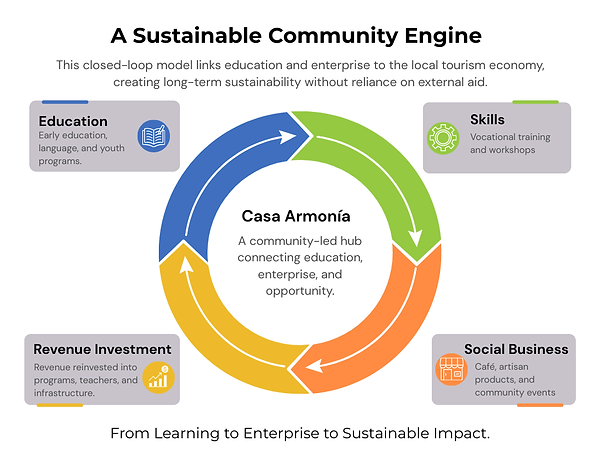
HOW THE MODEL OPERATES IN PRACTICE
Education
Tucan Learning Center provides early education and English programs that build foundational skills and expand access to tourism-related employment.
Skills & Enterprise
Workshops and vocational training strengthen practical abilities and support the development of local goods, services, and entrepreneurial pathways.
Revenue Reinvestment
Income generated through social business initiatives—including café operations, artisan products, and events—is reinvested into programs, teachers, and infrastructure.
LONG-TERM VISION
Beyond Programs: Building Infrastructure
Casa Armonía serves as the physical and organizational hub of this model. It houses education programs, vocational training, and social business activity within one integrated ecosystem.
The long-term goal is not simply to run programs, but to establish a replicable model for community-led development rooted in local participation and economic sustainability.
This is not charity.
It is community-owned capacity building.
